
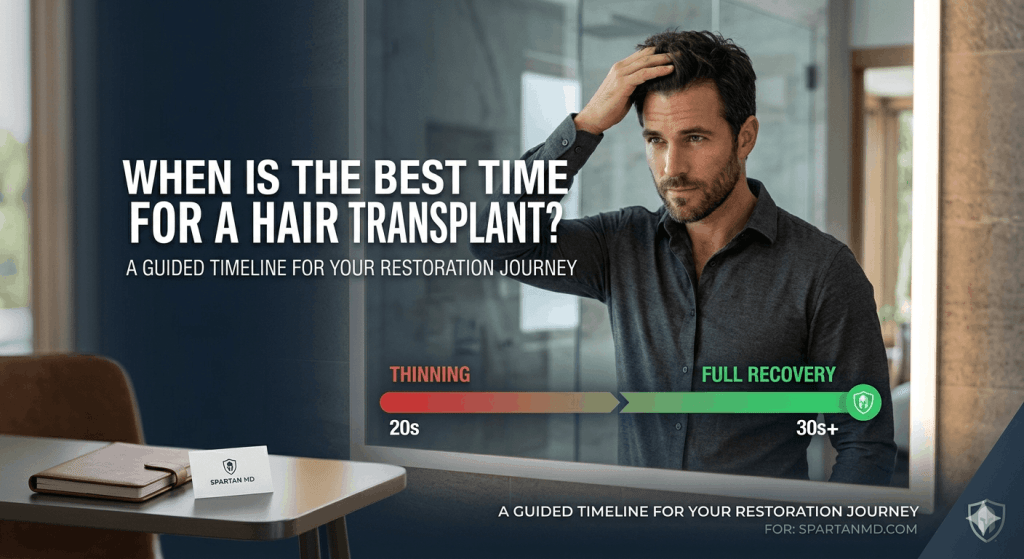
If you have been noticing a receding hairline every time you look in the mirror or seeing more scalp than hair on your crown, you are likely asking yourself: “When is the right time to get a hair transplant?”
Hair loss, especially Androgenetic Alopecia (AGA) or Male Pattern Baldness, is progressive. Once it starts, it doesn’t just stop on its own. While it’s human nature to wait and watch how quickly your hair is thinning, delaying treatment too long can limit your restoration options.
The truth is, there isn’t a single, universal “perfect age” for a hair transplant. However, there is an ideal personal window based on your age, hair loss stabilization, overall health, and goals.
At Spartan MD, we help you navigate this journey. Let’s break down the key factors that determine when you should move forward with a hair restoration procedure.
Male pattern baldness can start as early as 18. In fact, research shows that up to two-thirds of American men experience some degree of thinning by age 35, and nearly 85% face significantly thinner hair by age 50.
However, undergoing hair transplant surgery too early—specifically under the age of 25—is generally not recommended. Here is why:
Unpredictable Hair Loss Patterns: Hair loss patterns continue to evolve well into your late 20s. If you transplant hair too early, you may lose the native hair around the transplanted grafts, leaving “islands” of hair that look unnatural as you age.
The “Mature Hairline” Illusion: Between the ages of 18 and 29, a man’s hairline naturally changes, moving back about half an inch to an inch to form a mature “M” shape. This is completely normal and isn’t always a sign of permanent balding.
Limited Donor Hair: A hair transplant shifts healthy hair follicles from the “donor zone” (the back and sides of your head) to the balding areas. Shifting these resources too early might leave you with insufficient donor hair if you need another procedure down the road.
The Golden Window: Waiting until your hair loss stabilizes (typically around ages 30 to 45) allows our medical team to design a natural, long-lasting hairline.
Your genetics and family history play a massive role in how your hair loss will progress. Rushing into surgery without stabilizing your hair fall can lead to patchy results.
If you are in your early 20s and experiencing hair loss, the best approach is to start with proven non-surgical hair restoration treatments like Finasteride or Minoxidil. These treatments slow down thinning, strengthen existing hair, and create a stable foundation before any surgical intervention.
A hair transplant is a safe, minimally invasive procedure, but being in good physical health is essential for the best healing and graft survival.
Conditions like Type 2 diabetes must be well-managed.
You should always disclose your full medical history and any prescription medications during your medical consultation.
Physical indicators aside, the psychological impact of hair loss is a crucial factor. Studies consistently show that hair loss can negatively impact self-esteem, social life, and career confidence. Society often misperceives balding men as older or less energetic than they actually are.
If looking in the mirror is affecting your mental well-being or stopping you from living life to the fullest, then it is the right time to explore your options.
Absolutely. Age is rarely a barrier on the upper end of the spectrum. As long as you are in good health and have a sufficient, healthy donor area at the back of your scalp, a hair transplant can yield incredible, youth-restoring results well into your 50s, 60s, and beyond.
You don’t have to guess whether the time is right. The best way to know if you are ready for a hair transplant is through a professional scalp evaluation.
At Spartan MD, we analyze your hair loss pattern, donor density, and health goals to create a customized restoration plan—whether that means a state-of-the-art hair transplant or an advanced non-surgical therapy.
King of Prussia has everything that allows us to provide concierge-level service. We have a white glove service where arrange a hotel, meals and transportation for someone who is coming in from further away. KOP makes this so easy to coordinate because it really has anything we need. Eventually, we want to be present all along the East Coast.